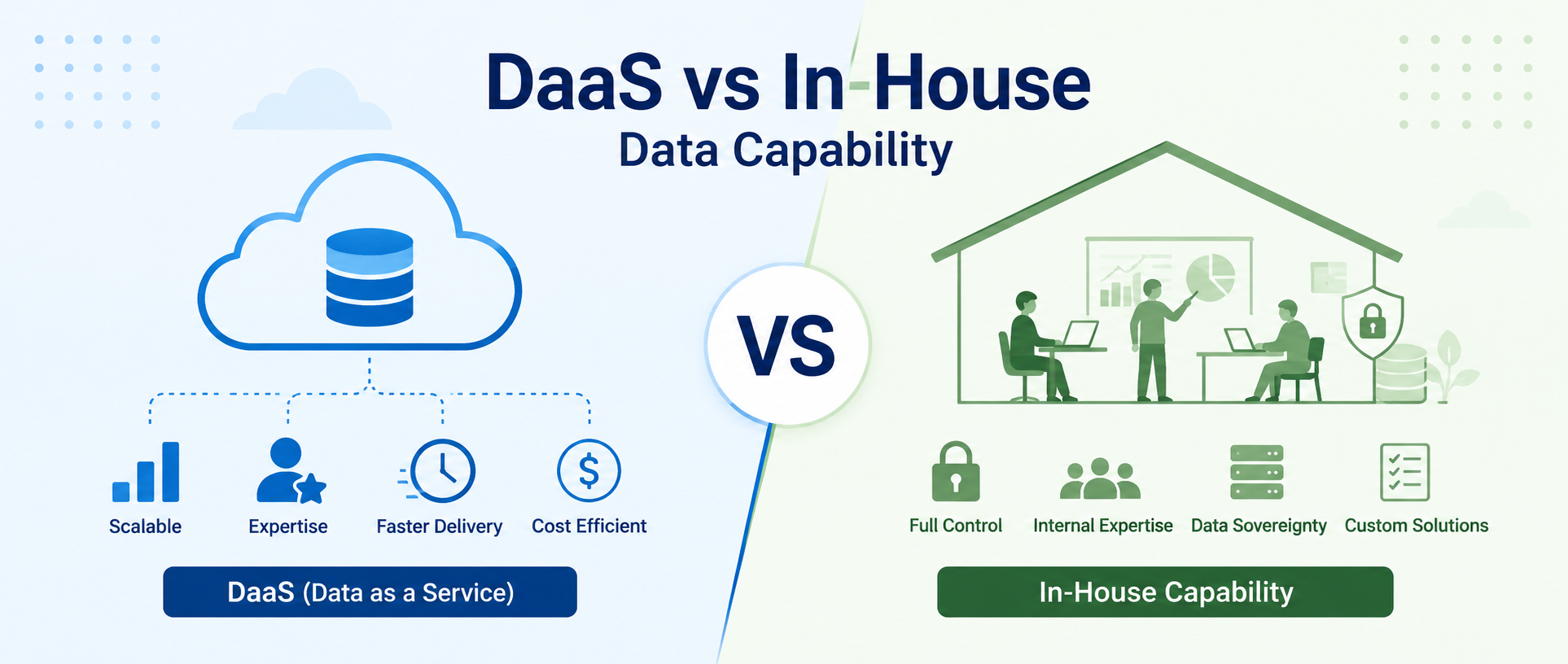
Public sector data strategies often stall not because of poor intent, but because of structural decisions made early in a programme and rarely revisited. One of the most consequential is the choice between Data as a Service (DaaS) and building in-house data capability. This decision influences the pace of implementation, long-term cost structure, and the level of institutional control over data assets. Research on digital government transformation from organisations consistently highlights governance design and capability models as critical determinants of public sector data programme success.
When evaluating DaaS vs In-House Data Capability, organisations must consider governance requirements, implementation speed, long-term costs, and strategic objectives before selecting the most appropriate model.
DaaS models typically provide rapid access to infrastructure and specialist expertise, while in-house capability emphasises long-term control, institutional knowledge, and internal governance maturity. The appropriate choice usually depends on the organisation’s current data maturity, the sensitivity of the data involved, and the long-term operational role data is expected to play.
How the Two Models Compare
| Dimension | Data as a Service (DaaS) | Build In-House Capability |
|---|---|---|
|
Time to Value |
Faster deployment because the provider preconfigures infrastructure and services
|
Typically requires longer setup as architecture, governance, and teams are developed internally
|
|
Upfront Investment
|
Often structured as operational expenditure through subscription or managed services
|
Requires investment in platforms, talent, and governance frameworks
|
|
Long-Term Cost Structure |
Costs scale with usage and contractual scope
|
It may become more cost-efficient when the capability is widely used and well-governed
|
|
Data Sovereignty
|
Data may be processed within vendor-managed environments, depending on service design.
|
Greater direct organisational control over data pipelines and governance
|
|
Talent Requirements
|
Lower internal technical staffing is required initially
|
Requires sustained investment in engineering, analytics, and governance expertise
|
|
Scalability |
Capacity can expand through vendor infrastructure and services
|
Expansion may depend on hiring, procurement cycles, and internal infrastructure
|
|
Governance Control
|
Shared responsibility with the service provider
|
Governance policies and controls are managed internally
|
|
Risk Profile
|
Vendor dependency and contract management considerations
|
Delivery risk, talent retention, and platform management responsibilities
|
When DaaS May Be Effective
DaaS models are often useful when speed of implementation is a priority. Managed platforms can reduce the need to build infrastructure from the ground up, enabling organisations to begin generating analytical outputs relatively quickly. This can be particularly valuable in policy environments where timely insights are needed to support operational or regulatory decisions.
DaaS may also be appropriate when data governance and architecture are still evolving. Organisations that have not yet consolidated data sources or established clear governance frameworks can sometimes gain early value from a managed service while simultaneously strengthening internal processes.
Another scenario where DaaS can be beneficial is when specialised analytical capabilities are required—for example, advanced geospatial analytics or cross-agency data integration. External providers often develop deep expertise in these domains through repeated implementations across multiple organisations.
A commonly noted risk, however, is long-term dependency on a vendor ecosystem. Service contracts, data portability provisions, and exit strategies therefore require careful review during procurement.
When Building In-House Capability May Be Appropriate
In-house capability is frequently prioritised when data sovereignty and control are central policy concerns. Government departments managing sensitive citizen information, financial records, or security-related datasets often prefer architectures where governance, access policies, and operational control remain fully within the organisation.
This approach also tends to align with continuous operational use cases, such as ongoing service delivery monitoring, regulatory oversight, and long-term policy analysis. In these contexts, internal capability enables organisations to embed data analytics directly into operational processes rather than treating it as an external service.
From a financial perspective, some organisations find that internal platforms become more cost-efficient as usage grows, provided that governance and talent management are handled effectively. However, studies on public sector digital transformation emphasise that internal capability requires consistent investment in both technology and human capital, not simply infrastructure deployment.
One common implementation challenge is sequencing. Developing technical teams before establishing a clear data architecture can lead to fragmented reporting rather than a cohesive capability. Many digital government frameworks, therefore, emphasise the importance of aligning architecture design, governance standards, and workforce development.
Strategic Implication
The most effective public sector data strategies often avoid treating DaaS and in-house capability as mutually exclusive options. Instead, some organisations adopt a sequenced approach: using external services to accelerate early delivery while gradually building internal architecture, governance structures, and technical teams.
For public sector leaders, the central question is therefore not simply which model to adopt, but how the capability model aligns with long-term institutional goals for data governance, service delivery, and policy analysis. Decisions made early in a programme shape the flexibility, independence, and sustainability of data initiatives for years to come.
Navigating this decision for your organisation? Drop a comment or connect directly — the strategic framing matters as much as the technical one.
Data as a Service (DaaS) is a model where organisations access data infrastructure, analytics tools, and specialist expertise through an external provider rather than building and maintaining these capabilities internally.
DaaS provides managed analytics services and infrastructure through a third-party provider, while in-house data capability involves developing internal teams, systems, governance frameworks, and technical expertise to support data-driven decision-making.
DaaS is often the preferred option when organisations require rapid implementation, access to specialist expertise, lower upfront investment, and scalable analytics capabilities without building extensive internal infrastructure.
In-house data capability is typically more suitable when data sovereignty, governance control, regulatory compliance, and long-term institutional knowledge are strategic priorities.
DaaS can reduce initial implementation costs and accelerate access to analytics capabilities. However, organisations with long-term analytics requirements may find internal capability more cost-effective over time.
Yes. Many organisations adopt a hybrid approach, using DaaS to accelerate delivery while gradually building internal data capability, governance structures, and technical expertise.
Data governance helps ensure data quality, security, compliance, and accountability. Governance requirements often play a significant role in determining whether a managed service or internal capability is the most appropriate option.